
Have Tomatoes?

Dried Tomato Recipe

Prepare the Tomatoes

  • Thinly slice tomatoes and lay on parchment paper.

  • Place in oven at 225 - 250 degrees for 2 to 8 hours.

  • Let them sit in oven to cool for 30 minutes.

  • Ensure tomatoes are fully dehydrated and cooled to room temperature

  • Inspect for any remaining moisture before proceeding

  • Handle with clean, dry hands or utensils

2 Condition the Tomatoes

Conditioning equalizes moisture to prevent mold formation during storage.

  • Place tomatoes in a clean, airtight container

  • Store at room temperature for 5–10 days

  • Check daily for condensation; if present, return tomatoes to the dehydrator briefly.

Acidification reduces bacterial risk, especially for oil‑packed items.

  • Dip each tomato briefly in white wine vinegar

  • Allow excess vinegar to drip off

  • Work in small batches to maintain cleanliness

4 Add Flavor (Optional)

Additional acidity and aromatics enhance taste and stability.

  • Add a splash of red wine to the jar if desired

  • Add dried rosemary, dried fresh basil if desired

  • Avoid overfilling; keep liquids minimal to maintain oil coverage

5 Cover with Olive Oil

Oil protects the tomatoes from air exposure and improves shelf life.

  • Fill the jar with high‑quality olive oil, leaving headspace

  • Let jars sit for 5 minutes to release trapped air

  • Top off with more oil if tomatoes are not fully submerged

6. Seal and Refrigerate

Initial refrigeration stabilizes the product before pantry storage.

  • Seal jars tightly and refrigerate for 24 hours

  • After 24 hours, move sealed jars to the pantry

  • Once opened, keep refrigerated to prevent spoilage

  • Monitor for off‑odors or cloudiness as signs of contamination
What To Do in Your Backyard in August

Average Temperatures: High 92   Low 73

Monthly Average Rainfall 6.25 inches

 Plant in August

 Vegetables: Cantaloupe, collard, corn, cucumber, eggplant, lima bean, okra, pepper, pumpkin, snap bean, southern pea, squash, tomato and watermelon

Flowers: Angelonia, begonia, black-eyed Susan vine, blue daze, butterfly weed, bush daisy, cat's whiskers, chrysanthemums, coleus, coreopsis,  crossandra, fire spike, gaura, golden globe, heliconia, jacobinia, impatiens, lantana, marigold, melampodium, moon flower, pentas, periwinkle, porter weed, portulaca, purslane, salvia, Stokes aster, sunflower, torenia and zinnia.

Herbs: Anise, basil, bay laurel, chive, dill, ginger, lemon balm, Mexican tarragon, mint, oregano, rosemary, sage, sweet marjoram and thyme.

Bulbs type plants: African iris, agapanthus, amaryllis, bulbine, canna, crinum, crocosmia, day lily, gladiolus, gloriosa lily, kaffir lily, Louisiana iris, society garlic, rain lily and walking iris.

 Lawn Care

  •  Lawns appearing yellow can have an iron treatment instead of fertilizing.

  • Sod webworms have been feeding in lawns; apply Summit Caterpillar and Webworm Control.

  • Turn off irrigation systems during rainy periods; turf only needs 1.5” of rainfall or water a week.

  • Overwatered lawns should be weaned off irrigation with the summer rains. They may decline and wilt for a few weeks, but will recover.

  • Allowing your lawn to wilt a little between waterings helps deepen the root system.

  • Raise or replace pop-up sprinkler heads that don’t reach far enough above the sod.

  • Mow frequently and at the recommended height; sharpen dull mower blades.

  • Fill bare areas with sod, plugs or seed to take advantage of the good growing weather.

  • Wait until Fall to sod shady areas to prevent decline due to excessive moisture.

  • New lawns are susceptible to fungal problems; apply fungicide to help reduce decline.

  • Have problem turf samples diagnosed at your local University of Florida Extension Office.

  • Mushrooms are common in lawns after rains. Removal is not necessary but can be done.

  • Smelly mushrooms are often called stinkhorns; they are poisonous.

  • Control weeds that are filling bare spots and over growing the good grass by hand removal.

  • Consider another ground cover for hard to maintain and problem turf areas

  • Weed killers should not be used when temperatures are above 85 degrees.

 Landscape care

  •  Landscape plantings make lots of growth during summer; prune to keep in bounds.

  • Springtime flowering shrubs like azaleas, camellias, gardenias, hydrangeas, loropetalums, should not be pruned.

  • Thinning out excessive growth can help many shrubs avoid disease problems. 

  • Many shrubs & flowers need a summer feeding; fertilize where permitted.

  • Renew mulch layers to control weeds: keep them back a few inches from stems and trunks.

  • Summer rains can cause container plants to decline, check for proper drainage.

  • Do not count on summer rains to water new plantings; most need daily hand watering.

  • Use a slow-release fertilizer that feeds the plantings for several months.

  • Don’t let vines climb trees and shrubs; train them to arbors and trellises.

  • Give palms a break; only remove the dead fronds and old flower heads.

  • Complete pruning of poinsettias, bougainvillea, and wisteria by month’s end.

  • Edge walkways and driveways to keep the landscape attractive.

  • Summer rains normally provide adequate moisture for established plants; water as needed.

  • Use foliage plants in shady gardens during the warmer months.

  • Avoid trimming sheared plants back to the same height; allow a little new growth to remain.

  • Stake newly planted small trees and shrubs that might be affected by wind.

  • Feed crape myrtles where permitted and remove seed heads to continue summer blooms.

  • Yellowing and leaf drop of crape myrtles are often due to a fungus. The leaves will drop anyway in Fall, no need to treat.

  • Caladiums may start to decline by month’s end which is normal.

  • Trim both declining flowers and foliage from perennial beds.

  • Divide bromeliads, Shasta daisies, day lilies and other landscape perennials.

  • Gladiolus can be left in ground if soil is dry.

  • Transplant palms and sagos.

  • Start poinsettia cuttings in early August.

  • Pinch the tips of chrysanthemums in early August to grow well-branched compact plants.

  • Feed water lilies and bog plantings in home water gardens monthly.

 Foliage & house plant care

 Time to prepare foliage plants for Fall; reshape and trim to encourage new growth.

  • Transplant root bound and poorly drained foliage plants, add new soiol.

  • Check for mealy bugs, scales and mites; control with natural soap or oil insecticides.

  • Make cuttings of your favorite plants.

  • Feed all foliage plants with a slow-release fertilizer where permitted.

  • Look for new plants to add to the collection.

  • Indoor plants accumulate dust like furniture; rise with water or a mild soapy solution.

  • Move light starved plants outdoors to a shady location.

  • Enjoy orchids and bromeliads indoors when in bloom, then move outside to the shade.

  • Divide clump forming foliage plants like Spathiphyllum and Sansevieria.

 Vegetable & fruit care

  •  Prune mangoes and lychee after harvesting fruit.

  • Check pineapples – fruits are ready when fragrant and turn yellow to orange.

  • Feed bananas and figs monthly but lightly; keep moist and mulched.

  • Many gardens are filled with summer weeds; remove by hand.

  • Enrich sandy soils and old garden sites with organic amendments and manure.

  • Test soil acidity and adjust the pH if needed before planting in ground and in containers.

  • Remove plastic from solarization after treatments and plant immediately.

  • Transplants started in July should be ready for the garden during mid to late August.

  • Plant quick growing warm season vegetables mid-August through early September.

  • Seeds of melons and pumpkins must be planted during early August.

  • Grow vegetables in large containers with good potting soil if you have limited space.

  • Give tomatoes an extra-large container and keep moist to prevent blossom-end rot.

  • Groom and feed herbs monthly; shelter container-grown herbs from the daily rains.

  • Mints in containers that stop growing may only need dividing and more fertilizer.

  • Clean containers between crops and add fresh potting soil.

  • Plant flowers that attract pollinators among vegetables to obtain better fruit set.

  • Where possible plant nematode resistant tomato and other vegetable varieties.

  • Open wide, 8 inch or deeper holes in nematode infested sties and fill with fresh pest free soil.

  • Begin staking or trellising taller growing crops when young.

  • Mulch new plantings to conserve water and promote better plant growth.

  • Feed sweet potatoes monthly and check dates of planting to harvest potatoes in 100 days.

  • Feed citrus with one-quarter pound of citrus fertilizer per inch of trunk circumference.

  • Apply a minor nutrient spray and insecticide to citrus at each flush of new growth.

5.  A 12’ tall totem pole constructed with black bowling balls with a white pins at the top..

4. A work of art created out of garden tools that was all connected by a pipe structure into a water feature. This entire piece of art was painted monochromatic matte black in homage to the Russian immigrant artist, Louise Neveleson, whose work is in famous museums around the world.

3. Hair salon painted Styrofoam heads filled with sedums and succulents. The colors were brilliant blues, yellows, greens, oranges, some with sunglasses.

2. Eclectic artwork, made from ceramic, glass, metal, porcelain, and other very strange materials.

1, Statues of Buffalos made of every material, color, shape, and size imaginable, from 6” tall to real life size one-ton buffalos.

Teresa’s Top Five Zinnias To Beat The Heat

Zinnias were the first flowers I learned to draw—and they’re easy to love. In my view, they’re among the most enjoyable long-lasting annuals to grow. Whether you’re a child, a beginner gardener, Master Gardener, or a professional landscaper, zinnias provide vibrant color, summer-long blooms, few pest problems, and minimal maintenance. These are my five favorite zinnia varieties from Burpee seeds for a pollinator garden or meadow—plant a few now!

  1. Macarenia zinnias bring vivid spicy-orange color to the garden. Their 3" blooms last all summer, brightening beds, borders, containers, and cut-flower gardens, with colors that deepen as the flowers mature. Burpee 35 seeds, $8.95.

  2. Raspberry Lemonade zinnias’ bold 2–3" blooms bring a colorful display to borders and containers. The vibrant mix features coral, yellow, and starlight rose, offering easy-care, long-lasting summer color with strong disease and drought tolerance. Burpee 25 Seeds $6.95

  3. Giant flowered zinnias are dynamic! These sturdy, bushy flowers produce huge 5" double blooms that look like dahlias and add bold, vibrant color to the garden. Heat-loving and easy to grow, they keep flowering more as you cut them, making them a summer bouquet favorite. Burpee 150 seeds $5.45 and 375 seeds $7.95

  4. Tequila Lime zinnias are large, bright zinnias feature crisp, citrus-green blooms up to 3" wide. Their rounded flowers add a lively lime-colored pop to the garden and are ideal for cutting and arranging. Purchase Burpee 50 seeds $6.95

  5. Cactus Flowered Zinnias are an enduring Heirloom variety. Narrow, quilled petals give these heirloom zinnias distinctive flair. Introduced as Burpee’s “breakthrough” zinnia in the 1920s, this mix produces double and semi-double blooms up to 5" wide in scarlet, rose, orange, white, and yellow. Exceptional for cut flowers. Burpee 100 seeds $4.95

You can seeds in seed-starting trays and pots or directly into your garden. Seeds will germinate in 7 to 10 days. If needed, thin flowers out as they reach 1” to 2”, spacing them one half of the variety’s mature height. (See on seed packet) Keep consistently moist, watering if no rain 1x - 2x a week. But do not overwater. Container plants may need more watering oversight depending on pot material. To prevent fungal issues, water in early morning between 4am and 6am.

Photo credit: Burpee

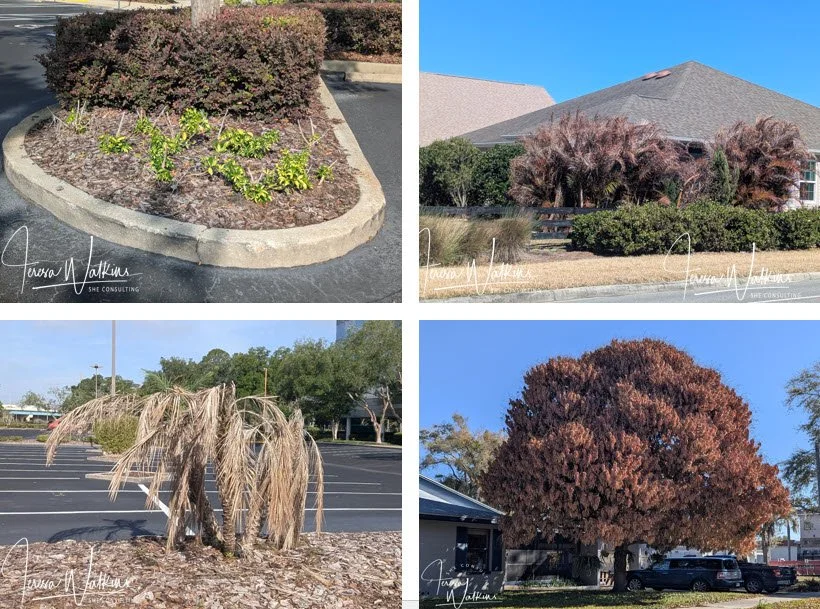
Frozen schedflera, pygmy date palms, palms, and mangos.

The late-January to early-February winter freeze brought severe cold to Florida and much of the Southeast. There was no way to prepare or protect landscapes from the Polar Vortex coming. After record highs near 90 °F in the Miami area on January 26, temperatures across the city dropped to 48–51 °F by the next morning. By February 1, several Florida cities recorded their coldest temperatures since 2010: Tampa reached 28 °F, Miami and Fort Lauderdale recorded 35 °F, Orlando fell to 25 °F, and Daytona Beach hit 23 °F, setting a record for its coldest February day. Many Florida cities posted daily record lows on February 2, including Gainesville, Florida, at 22 °F, while Jacksonville, Florida, tied a record on February 3rd with its eighth consecutive freezing morning.

The freeze caused significant damage, killing many tropical shrubs, palms, and trees and leaving landscapes looking scorched and barren.  Landscapers and homeowners alike were overwhelmed. Completely unavoidable.

But it’s almost six months later and landscapes are still not back to normal. Frozen palm fronds are still hanging on, Norfolk Island Pines are still brown, dead schefflera shrubs, and full canopies of brown mango leaves are seen across the distance over white PVC fences.

If you are still living with a winter-damaged landscape, look closer, you might be seeing signs of life coming back to these injured shrubs and trees. Crotons and hibiscus have sprouted new foliage and are recovering well. If dead branches remain on your tropical plants, use sterile pruners to cut them back to the base of the shrub. For palms, remove only the brown fronds.

Mangos and papayas are also leafing out. Even Norfolk Island pines are producing bright green new growth. The hard part—and I think it’s not only a financial cost but an emotional decision—will be to prune off the dead branches or cut the tree down. If your tree is more than 10 feet tall, this work may require a certified arborist. Proper pruning helps the tree grow correctly, while poor pruning can make it more vulnerable to disease, insects, and hurricane wind damage.

“We are assessing the freeze-damaged trees as targets, eyesores, and not good for the overall health of the tree,” Perry Tollman, owner of Word-of-Mouth Tree Service, Altamonte Springs responded. “We do recommend trimming out the large deadwood, as it begins to desiccate the plant, so that it’s less of a hazard and aesthetically more pleasing.”

Have a company with certified arborists assess your brown tree. You’ll gain peace of mind, your tree will be healthier, and your neighborhood will look better. It’s time.

Source:

Atienza, J. (2026, February 2). Freezing in Florida: Arctic chill reaches Sunshine State, breaking records and causing power disruptions. FOX Weather. https://www.foxweather.com/weather-news/freezing-florida-arctic-chill-breaking-records-power-outage

Jones, R. (2026, February 3). Record Tying 8th Freeze, Milder Days Ahead. https://www.wokv.com/news/local/wokv-show-notes-february-3-2026-record-tying-8th-freeze-milder-days-ahead/QBAAVUAFLZAFRPX2Y4LBP5TM2Q/

What to Do In Your Backyard in July

 What to Plant

Vegetables: Boniato, calabaza, cherry tomato, okra, Southern pea, Seminole  pumpkin, sweet cassava, roselle, sweet potato and yard-long bean; start transplants of eggplant, peppers and tomatoes from seed in mid-July.

Flowers: Angelonia, ageratum, begonia, blue daze, bush daisy, butterfly plant, bulbine, cat's whiskers, coleus, crossandra, false heather, fire spike, gaillardia, ginger, goldenrod, impatiens, Joseph’s coat, lantana, marigold, melampodium, Mexican petunia, Mexican sunflower, moon flower, ornamental sweet potato, pentas, periwinkle, porter weed, portulaca, purslane, salvia, sunflower, torenia and  classic zinnia.

Herbs: Anise, basil, bay laurel, chive, dill, ginger, lemon balm, Mexican tarragon, mint, oregano, sage, sweet marjoram and thyme.

Bulb-type plants: Achimenes, African iris, bulbine, caladium, canna, crinum, crocosmia, day lily, eucharis lily, gladiolus, gloriosa lily, peacock ginger, society garlic, spiderwort, rain lily and walking iris.

Lawn care

  • July is a good time to fill in bare or now weedy spots left by drought or pests. 

  • Summer fertilizer applications are prohibited in many areas; find out what is allowed in your county..

  • Application of an iron only product can help lawns keep their green color where permitted.

  • Determine the proper height for your lawn type; grasses are mowed at different heights.

  • Mow once or twice a week to keep lawns at their proper height after normal growth.

  • Mow in a different direction at each cutting to prevent ruts

  • Never mow when the grass is wet from dew or rainfall.

  • Avoid mowing when the lawn is hot and dry to prevent damage from mower wheels.

  • Summer weed control may cause turf decline; try spot treating weeds to avoid injury.

  • Learn to identify lawn weeds and use appropriate controls.

  • Seasonal rains often provide adequate moisture; water only during dry times. 

  • Trim overgrown shrubs and turf grass hiding sprinklers to ensure proper watering.

  • Lawn moths are very active right now, control sod webworms when chewing damage is noted.

  • Chinch bugs have been active in St. Augustine lawns; control at first sign of turf decline.

  • If lawns are older than  3 to 4 years, you may notice thatch in lawns; it can cause the turf to decline.

  • Check for mealybugs, billbugs and nematodes in zoysia lawns and treat as needed.

  • New lawns can be established from seed, sod or plugs

  • Avoid sodding shady spots during the rainy season to prevent decline due to rot problems.

  • Grass is often hard to establish under trees due to shade and roots; select another ground cover.

Vegetable and fruit care

  • Very few popular vegetables like the heat and rains; many planters rest their gardens.

  • Plant Caribbean, African, and Asian vegetables this month.

  • Do control weeds in and near the gardens that flourish with the rains.

  • Consider soil solarization during summer as a way to bake pests out of gardens.

  • Buy and start seeds of tomato, pepper and eggplant seeds for mid-August transplants.

  • Make sure all gardens have daylong full sun exposure and a nearby water source.

  • Add organic matter to sandy soils and old garden site to have them ready for planning.

  • Local compost, manures or commercial garden soils are good sources of organic matter.

  • Use only composted manures or till manures into the garden 90 days before planting.

  • Test the soil acidity of planting sites and adjust the pH as needed.

  • Remove declining crops to help eliminate pests before the next plantings.

  • Seldom is it worth continuing lingering tomato, peppers and eggplants into fall.

  • Feed summer vegetable plantings monthly or use a slow release fertilizer as instructed.

  • Many herbs struggle during hot wet summers; groom, feed lightly and keep a bit dry.

  • Locate or order seeds for late summer planting; place in a plastic bag in the refrigerator.

  • Give fruiting trees and shrubs a mid summer fertilizer application.

  • Select fruits you like to grow and add them to the landscape; make sure they stay moist.

  • Apply insecticide and minor nutrient spray to citrus trees at each flush of new growth.

  • Keep figs moist, feed lightly and maintain a mulch to avoid summer fruit drop.

  • Prune blueberries when the harvest is over; also check and adjust the soil acidity.

  • Remove declining stems from black blackberries to allow new growths to restart the bushes.

  • Give fruit trees light trimmings as needed to direct growth.

In The Landscape

  • Summer rains have stimulated lots of new growth; perform timely pruning as needed.

  • Don’t wear out your plants; allow them to grow a little or cut them back to grow new shoots.

  • Use of hand pruners to selectively remove stems or stem portions is the best way to trim plants.

  • Lower limbs can be removed from trees that interfere with traffic or work.

  • Groom roses to remove faded blooms, tall stems and declining portions.

  • New trees, shrubs and ground covers can be planted; do keep the root balls moist.

  • Pruning time for azaleas and camellias is over; continue to prune gardenias and bougainvillea.

  • Hibiscus, crape myrtles and similar summer bloomers can be pruned but you lose the color.

  • Remove 4- to 6-inches of new growth from poinsettias to encourage compact growth.

  • Prune hydrangeas to remove old flower clusters and reshape plants when the blossoms fade.

  • Hang orchids from trees and feed every other week for best growth and flowering.

  • Use easy to maintain container gardens as accents for entrances, porches and patios.

  • Feed outdoor container plantings every two weeks or use as slow release fertilizer as labeled.

  • Daily rains may not completely moisten container gardens; check frequently for water needs.

  • Weeds grow as well as desired plants; pull, hoe or chemically control as needed.

  • Maintain mulch layers at 3 to 4 inches with trees and shrubs.

  • Delay transplanting established in ground trees and shrubs until late fall or winter.

  • Mushrooms are common during the rainy season; remove them if children or pets are present.  Divide and replant perennials including shasta daises, gerbera, bromeliads and many bulbs.

  • Trim seed heads from spring flowering annuals and perennials; save seeds for replanting.

  • Root 4- to 6-inch tip cuttings from shrubs and perennials.

  • Feed water gardens monthly and remove declining foliage and blooms.

  • Feed new and established palms every other month or use a slow-release fertilizer as labeled.

  • Many palms are declining due to diseases; sterilize pruners between palms to prevent the spread.

  • Leave as many green fronds on your palms as possible to keep them vigorous and healthy. 

  • Prune hedges when the new growth reaches 6- to 12-inches or allow them to grow naturally.

  • Mosquitoes are a concern when working in the landscape; apply repellents and coverup.

  • Empty water from pots, old tires and similar containers to help reduce mosquitos. 

House and foliage plants

  • Consider low light container gardens for long lasting indoor foliage displays.

  • Use foliage plants in shady areas of patios, at entrances and along walkways.

  • Groom and divide indoor plants to keep them attractive.

  • Trim overgrown house plants; use trimmings for cuttings.

  • Transplant root bound foliage plants into larger containers.

  • Make sure new containers and established plants have adequate drainage

  • Adding pebbles or pieces of pots to the bottom of containers is still a good idea.

  • Feed home and outdoor foliage plants with a slow-release fertilizer as instructed.

  • Check for summer pests of mealybugs and scale insects, control with natural sprays

  • Ask a friend to care for your plants during vacation or move them outside to a shady spot

Yaupon Holly Tea Recipe

Yaupon holly (Ilex vomitoria) is North America’s only native caffeine-containing plant and has been brewed as tea by Indigenous peoples for centuries. Here are the harvesting tips and recipe from the UF/IFAS Extension.

Harvesting

  • Best times: Harvest during spring and fall flushes, when leaves are tender and flavorful.

  • Method: Snip young stems, then strip the leaves by hand or with a machine.

  • Limit: Remove no more than one-third of the canopy at once; foliage can regrow within a week if branches remain intact.

  • Plant choice: Choose male plants (no berries) when possible, since female plants produce toxic berries.

  • Leaf selection: Pick light-green new growth for a milder, grassier flavor.

  • Wash: Rinse the leaves and remove stems, berries, or debris.

  • Dry: Spread leaves in a single layer to air-dry or use a dehydrator.

  • Optional roasting: Roast lightly at about 300°F for 8 minutes, or over a fire, to deepen aroma and reduce bitterness.

  • Grind: Grind to a fine texture, if desired.

Brewing

  • Fresh leaves: Steep 1–2 teaspoons in hot water for 3–5 minutes for a green tea‑like infusion 

  • Roasted leaves: Steep for 3–5 minutes for a darker, bolder tea 

  • Example small‑batch method:

  • Use 1 tablespoon of leaves/stems (fresh or roasted).

  • Add to 2 cups boiling water.

  • Steep 3 minutes.

  • Strain and enjoy 

    Flavor Notes

  • Fresh leaves yield a light, green tea‑like brew with a grassy aroma.

  • Roasted leaves produce a darker, earthier flavor 

  • Yaupon tea contains as much caffeine as green tea and similar antioxidant levels to blueberries.

Safety & Tips

With these steps, you can brew yaupon tea at home using native Florida plants or purchased leaves for a naturally caffeinated, antioxidant-rich drink.

Resources: UF/IFAS Extension, LawnsTrees.com

2nd Full Moon in June is the Gator Moon

June 29, 2026, 7:57 PM: Full Gator Moon – Time of year when alligators are most active as they enjoy the summer heat, and summer boating stirs up fish and birds for more food supply. Mating season occurs in May through June.

Be careful around lakefronts, waterfront parks, retention ponds, and wetlands.

  • Keep at least 10–15 feet away from any alligator.

  • Never approach, feed, or handle an alligator — feeding is illegal and dangerous because it reduces their natural fear of people.

  • Leash pets and keep them away from shorelines, since alligators may mistake them for prey.

  • Swim only in marked areas during daylight hours, and do not bring pets into the water.

  • Do not swim or wade in murky water where alligators may be concealed.

  • Be alert between dusk and dawn, when alligators are most active.

If you find you have an alligator in your neighborhood, call FWC’s toll-free Nuisance Alligator Hotline: 866‑FWC‑GATOR (866‑392‑4286).

For more information on alligators: Florida Wildlife Commission.

Teresa’s Top Five Patriotic Gardeners

5. John Bartram (1699–1779)

A Philadelphia naturalist and botanist, John Bartram was regarded as the leading American naturalist of his time. In 1728, he established what is now the oldest surviving botanical garden in North America and exchanged seeds and plants with European botanists, including Peter Collinson. Through his work, Bartram introduced 150 North American plant species to Europe.

4. Martha Washington (1731 – 1802)

In the 18th century, the kitchen garden was one of the most important parts of an estate. Created in 1760, Mount Vernon’s garden has remained largely unchanged and produced fruits, vegetables, and berries. Martha Washington played a central role in its success, overseeing the evening meal, which was expected to be both plentiful and elegant. As a skilled plantswoman, she understood that the quality of the table reflected directly on her household.

3. Thomas Jefferson 1743 – 1826)

Often called America’s first gardener, Thomas Jefferson created a 1,000-foot terraced vegetable and herb garden at Monticello. He cultivated more than 330 varieties from 99 species, including asparagus, beans, cabbage, cucumbers, kale, okra, peas, and herbs such as thyme, rosemary, and lavender. His detailed garden records and seed exchanges reflected a scientific approach to horticulture, while his use of native plants expressed his patriotic ideals.

2. Eliza Lucas Pinckney (1722–1793)

A South Carolina planter and botanist, Eliza Lucas Pinckney tested new cash crops and introduced important plants to the American colonies. She helped popularize indigo cultivation, which became a major export crop, and contributed to the growth of agricultural science in the Southern colonies.

1.Robert Prince (ca.1690 – 1737)

Robert Prince is credited with founding the first major commercial nursery in the United States in 1737 in Flushing, New York. Working with his son William, he established an eight-acre nursery that later became known as the Linnaean Botanic Garden and Nursery. The Prince Nursery grew into the largest and most influential horticultural enterprise in the colonies, specializing in:

—    Fruit trees, including apples, pears, cherries, plums, peaches, and apricots, many grafted for quality and disease resistance.

—    Grapes and ornamental plants.

—    International plant trade, including importing species from Europe and exporting American plants abroad.

—    Rose breeding and cultivation, with more than 600 varieties recorded by 1827.

—    Horticultural innovation, including pecan cultivation beginning in 1772 and the training of early American nurserymen.

Presidential Visits: George Washington visited in 1789; Thomas Jefferson and James Madison visited in 1791, with Jefferson placing a large order for Monticello.

The British protected the nursery due to its strategic value. During the war, over 10,000 grafted cherry trees were sold for barrel production. During the Revolutionary War, the British General Lord Howe ordered the protection of the Prince Garden and Nursery.  Over 10,000 grafted cherry trees had to be sold to be used in barrel manufacturing during the war.  After the war the orchard had to be rebuilt.

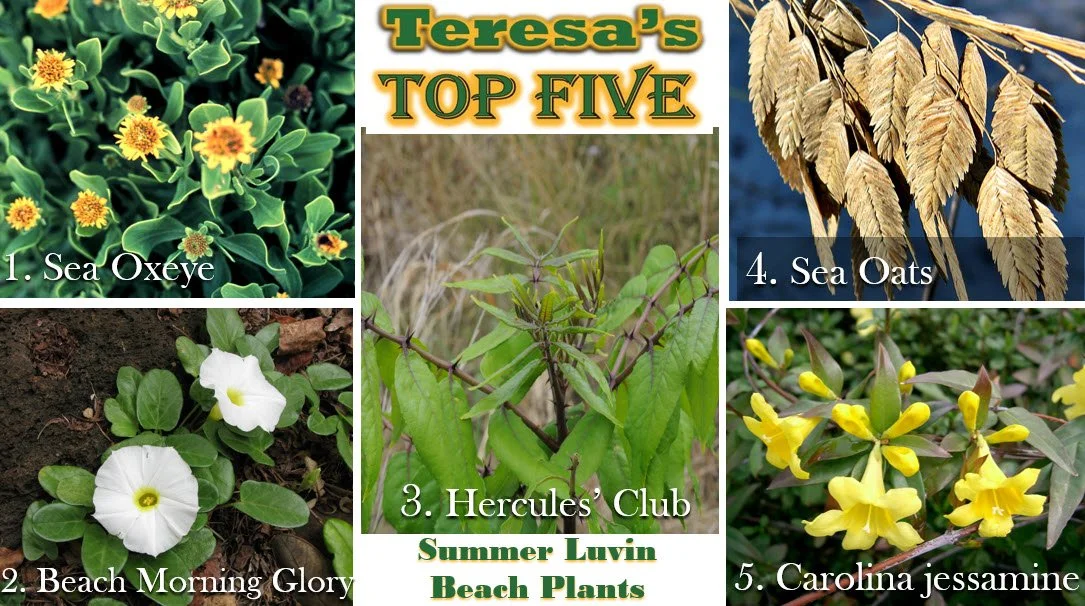
  1. Bushy seaside oxeye (Borrichia frutescens) is highly salt-tolerant, able to withstand short periods of drought and occasional saltwater inundation. Well suited to coastal restoration and landscaping, it works effectively as a border planting, in mixed wildflower gardens, and along retention pond edges. Spreading by rhizomes, it can form long-lasting colonies.

  2. Beach morning glory (Ipomoea imperati) is a trailing evergreen vine with showy white flowers that usually bloom in summer and fall, though flowering may occur year-round. Native to coastal dunes, it helps stabilize sand and tolerates drought, salt, and low-nutrient soils. Low-growing and non-climbing, it spreads quickly, making it best suited for coastal landscapes and dune restoration areas where it has room to sprawl. With regular maintenance, it can also be used as a groundcover in suitable conditions 

  3. Hercules’ club (Zanthoxylum clava-hercules) is an aromatic, heavily thorned tree with a rounded crown, spreading branches, yellow flowers, and fruit. It is used in landscaping, especially in natural areas and restoration projects, and serves as a host plant for giant swallowtail butterfly caterpillars. A member of the citrus family (Rutaceae), it is related to native citrus species such as wild lime. Also known as “toothache tree” or “tingle tongue,” its leaves, bark, and twigs can cause a tingling numbness in the mouth when chewed. Native Americans and early settlers used it medicinally to relieve toothaches.

  4. Sea oats (Uniola paniculata) are tall, spreading grasses that sway in coastal dunes and provide valuable habitat. Their flowers supply pollen for many insects, while their seeds feed beach mice, rabbits, and birds. In coastal landscapes, they serve as excellent foundation plants, tolerating hurricane-force winds and saltwater storm surge. Their deep, dense roots, which can reach 40 feet, anchor sand and help hold dune habitats together. Because of their important role in coastal protection, sea oats are protected under Florida law. Allow plenty of space, as they spread by rhizomes

  5. Carolina jessamine (Gelsemium sempervirens) provides welcome winter color and is among the first flowers to bloom in Florida, often appearing in early January. This easy-to-grow vine works well on fences and trellises, where its small leaves and twining stems create a light, airy look. It can also serve as a groundcover or climb trees, flowering in the canopy. Moderately fast-growing, it can be shaped or controlled with pruning, though it may sucker and spread beneath mulch. Note: toxic to children and pets