
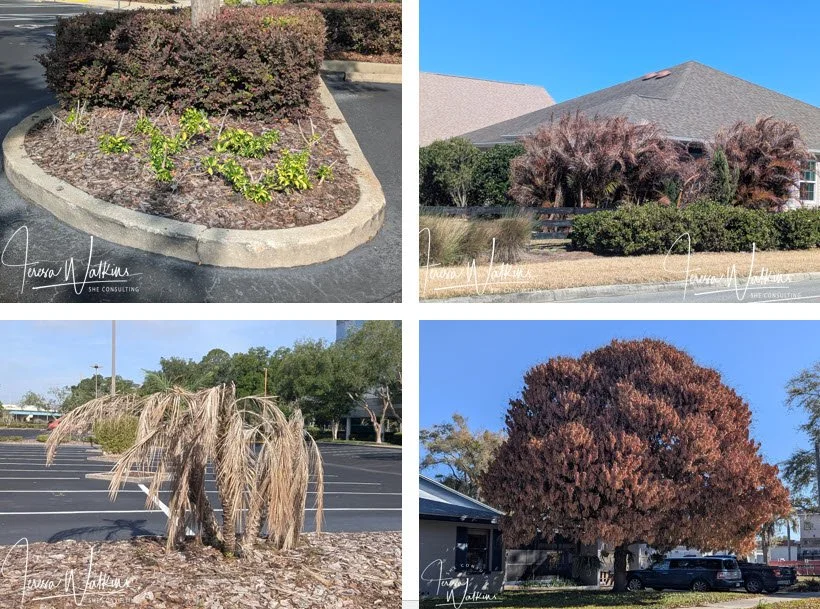
Frozen schedflera, pygmy date palms, palms, and mangos.
The late-January to early-February winter freeze brought severe cold to Florida and much of the Southeast. There was no way to prepare or protect landscapes from the Polar Vortex coming. After record highs near 90 °F in the Miami area on January 26, temperatures across the city dropped to 48–51 °F by the next morning. By February 1, several Florida cities recorded their coldest temperatures since 2010: Tampa reached 28 °F, Miami and Fort Lauderdale recorded 35 °F, Orlando fell to 25 °F, and Daytona Beach hit 23 °F, setting a record for its coldest February day. Many Florida cities posted daily record lows on February 2, including Gainesville, Florida, at 22 °F, while Jacksonville, Florida, tied a record on February 3rd with its eighth consecutive freezing morning.
The freeze caused significant damage, killing many tropical shrubs, palms, and trees and leaving landscapes looking scorched and barren. Landscapers and homeowners alike were overwhelmed. Completely unavoidable.
But it’s almost six months later and landscapes are still not back to normal. Frozen palm fronds are still hanging on, Norfolk Island Pines are still brown, dead schefflera shrubs, and full canopies of brown mango leaves are seen across the distance over white PVC fences.
If you are still living with a winter-damaged landscape, look closer, you might be seeing signs of life coming back to these injured shrubs and trees. Crotons and hibiscus have sprouted new foliage and are recovering well. If dead branches remain on your tropical plants, use sterile pruners to cut them back to the base of the shrub. For palms, remove only the brown fronds.
Mangos and papayas are also leafing out. Even Norfolk Island pines are producing bright green new growth. The hard part—and I think it’s not only a financial cost but an emotional decision—will be to prune off the dead branches or cut the tree down. If your tree is more than 10 feet tall, this work may require a certified arborist. Proper pruning helps the tree grow correctly, while poor pruning can make it more vulnerable to disease, insects, and hurricane wind damage.
“We are assessing the freeze-damaged trees as targets, eyesores, and not good for the overall health of the tree,” Perry Tollman, owner of Word-of-Mouth Tree Service, Altamonte Springs responded. “We do recommend trimming out the large deadwood, as it begins to desiccate the plant, so that it’s less of a hazard and aesthetically more pleasing.”
Have a company with certified arborists assess your brown tree. You’ll gain peace of mind, your tree will be healthier, and your neighborhood will look better. It’s time.
Source:
Atienza, J. (2026, February 2). Freezing in Florida: Arctic chill reaches Sunshine State, breaking records and causing power disruptions. FOX Weather. https://www.foxweather.com/weather-news/freezing-florida-arctic-chill-breaking-records-power-outage
Jones, R. (2026, February 3). Record Tying 8th Freeze, Milder Days Ahead. https://www.wokv.com/news/local/wokv-show-notes-february-3-2026-record-tying-8th-freeze-milder-days-ahead/QBAAVUAFLZAFRPX2Y4LBP5TM2Q/