
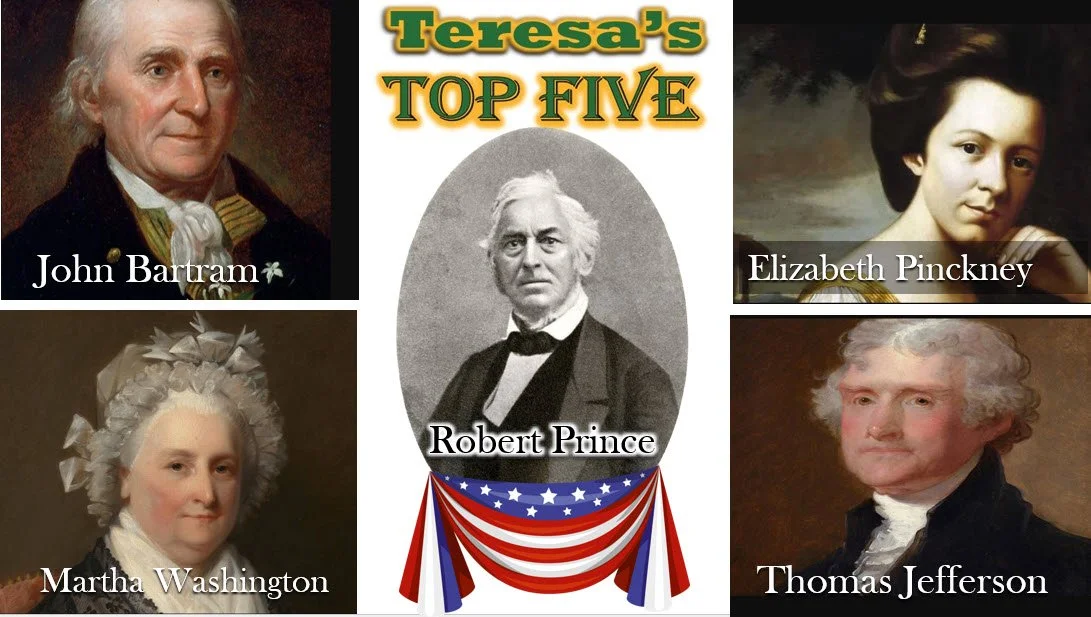
Teresa’s Top Five Patriotic Gardeners
5. John Bartram (1699–1779)
A Philadelphia naturalist and botanist, John Bartram was regarded as the leading American naturalist of his time. In 1728, he established what is now the oldest surviving botanical garden in North America and exchanged seeds and plants with European botanists, including Peter Collinson. Through his work, Bartram introduced 150 North American plant species to Europe.
4. Martha Washington (1731 – 1802)
In the 18th century, the kitchen garden was one of the most important parts of an estate. Created in 1760, Mount Vernon’s garden has remained largely unchanged and produced fruits, vegetables, and berries. Martha Washington played a central role in its success, overseeing the evening meal, which was expected to be both plentiful and elegant. As a skilled plantswoman, she understood that the quality of the table reflected directly on her household.
3. Thomas Jefferson 1743 – 1826)
Often called America’s first gardener, Thomas Jefferson created a 1,000-foot terraced vegetable and herb garden at Monticello. He cultivated more than 330 varieties from 99 species, including asparagus, beans, cabbage, cucumbers, kale, okra, peas, and herbs such as thyme, rosemary, and lavender. His detailed garden records and seed exchanges reflected a scientific approach to horticulture, while his use of native plants expressed his patriotic ideals.
2. Eliza Lucas Pinckney (1722–1793)
A South Carolina planter and botanist, Eliza Lucas Pinckney tested new cash crops and introduced important plants to the American colonies. She helped popularize indigo cultivation, which became a major export crop, and contributed to the growth of agricultural science in the Southern colonies.
1.Robert Prince (ca.1690 – 1737)
Robert Prince is credited with founding the first major commercial nursery in the United States in 1737 in Flushing, New York. Working with his son William, he established an eight-acre nursery that later became known as the Linnaean Botanic Garden and Nursery. The Prince Nursery grew into the largest and most influential horticultural enterprise in the colonies, specializing in:
— Fruit trees, including apples, pears, cherries, plums, peaches, and apricots, many grafted for quality and disease resistance.
— Grapes and ornamental plants.
— International plant trade, including importing species from Europe and exporting American plants abroad.
— Rose breeding and cultivation, with more than 600 varieties recorded by 1827.
— Horticultural innovation, including pecan cultivation beginning in 1772 and the training of early American nurserymen.
Presidential Visits: George Washington visited in 1789; Thomas Jefferson and James Madison visited in 1791, with Jefferson placing a large order for Monticello.
The British protected the nursery due to its strategic value. During the war, over 10,000 grafted cherry trees were sold for barrel production. During the Revolutionary War, the British General Lord Howe ordered the protection of the Prince Garden and Nursery. Over 10,000 grafted cherry trees had to be sold to be used in barrel manufacturing during the war. After the war the orchard had to be rebuilt.